Digital Product Passport platform for fashion brands
Krelup helps apparel and footwear brands comply with ESPR 2027 textile regulations by publishing transparent, QR-linked Digital Product Passports — making sustainability accessible for every brand, regardless of size.
For inquiries: hello@krelup.comBuilt for every brand, from first product to full catalogue
Compliance shouldn't be a privilege reserved for big teams with big budgets. Krelup makes Digital Product Passports and EU textile regulations accessible to every brand — whether you're launching your first collection or managing thousands of SKUs.
Small & independent brands
Publish your first DPP in minutes. No IT team, no consultants, no complexity — just your product data.
Growing brands
Scale your compliance programme as your catalogue grows. Templates, bulk upload, and automated environmental footprints keep you ahead.
Enterprise & multi-brand groups
Brand-level control, supply chain traceability, and audit-ready exports — built to handle the complexity of large operations.
Everything you need for DPP compliance
Digital Product Passports
Generate and publish QR-linked DPPs with fiber composition, care instructions, origin traceability, and certifications.
Branded DPP Templates
Choose from multiple DPP layout models and customise fonts and colour palette to match your brand identity.
Bill of Materials
Manage full product BOMs across design, proto, and production stages with revision history.
Environmental Footprint
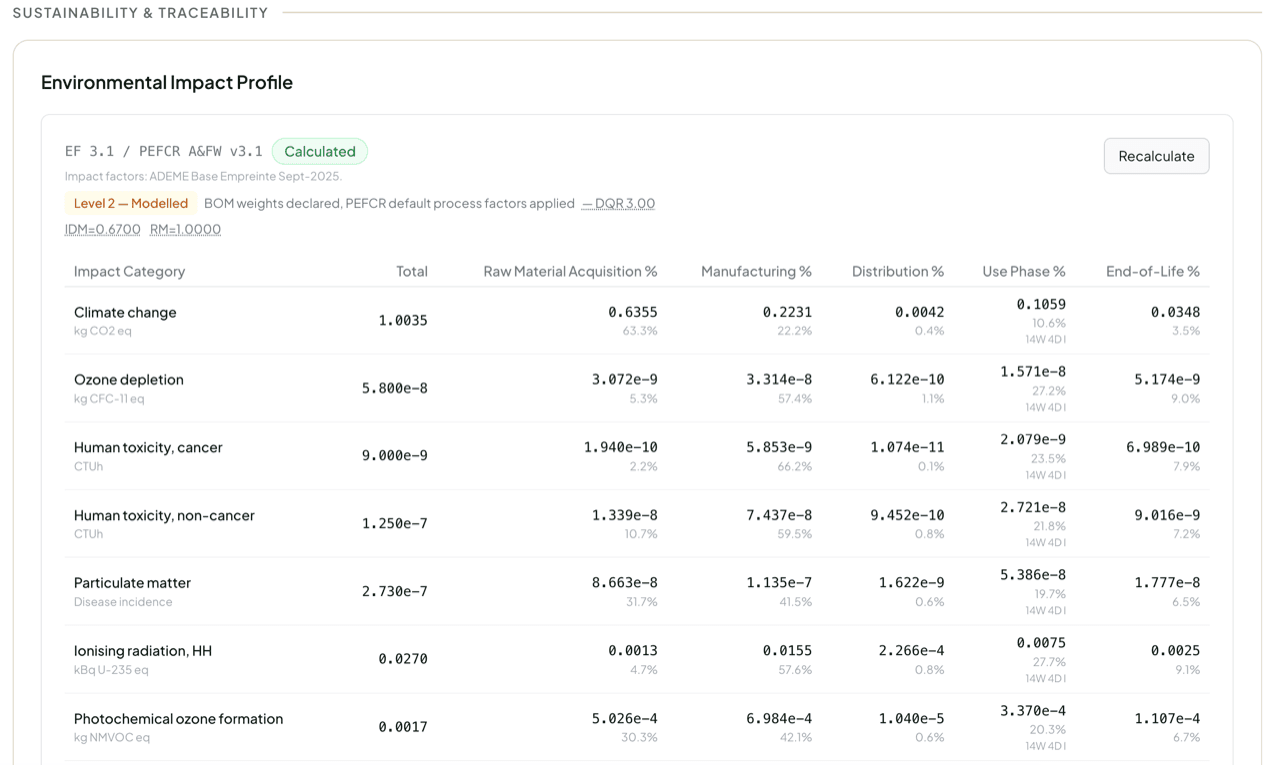
Estimate product carbon footprint using ADEME emission factors aligned with PEFCR 3.1.
DPP Readiness Score
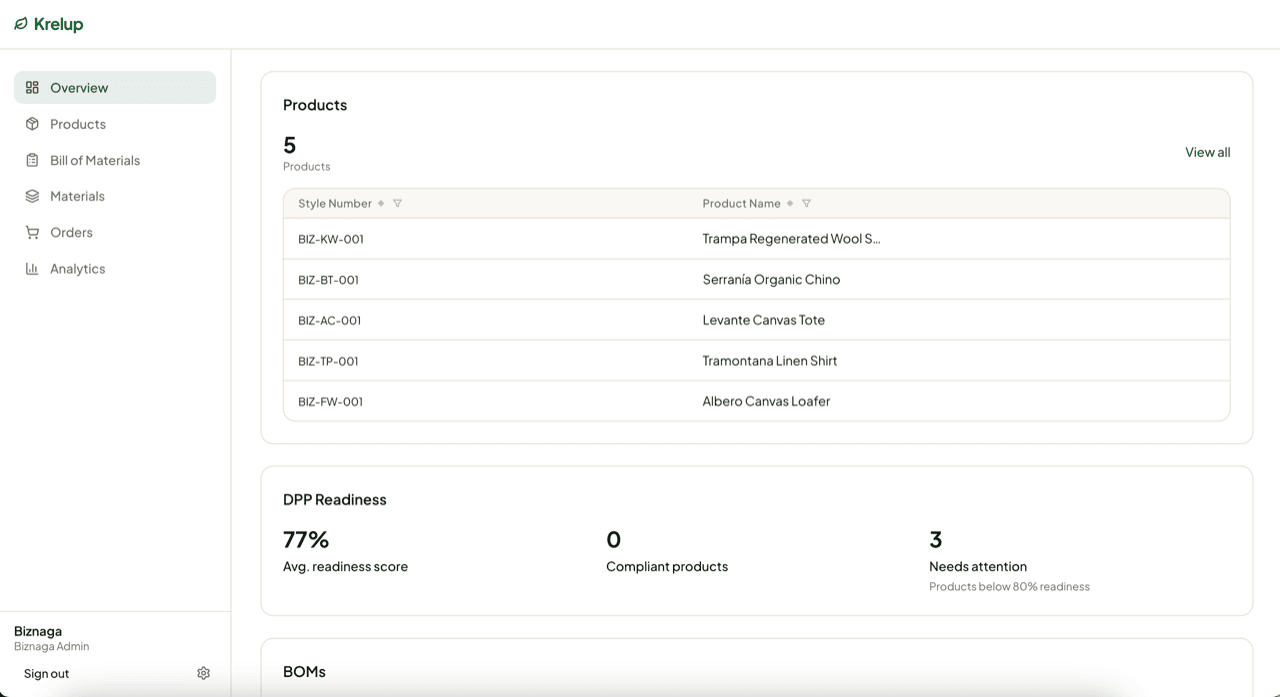
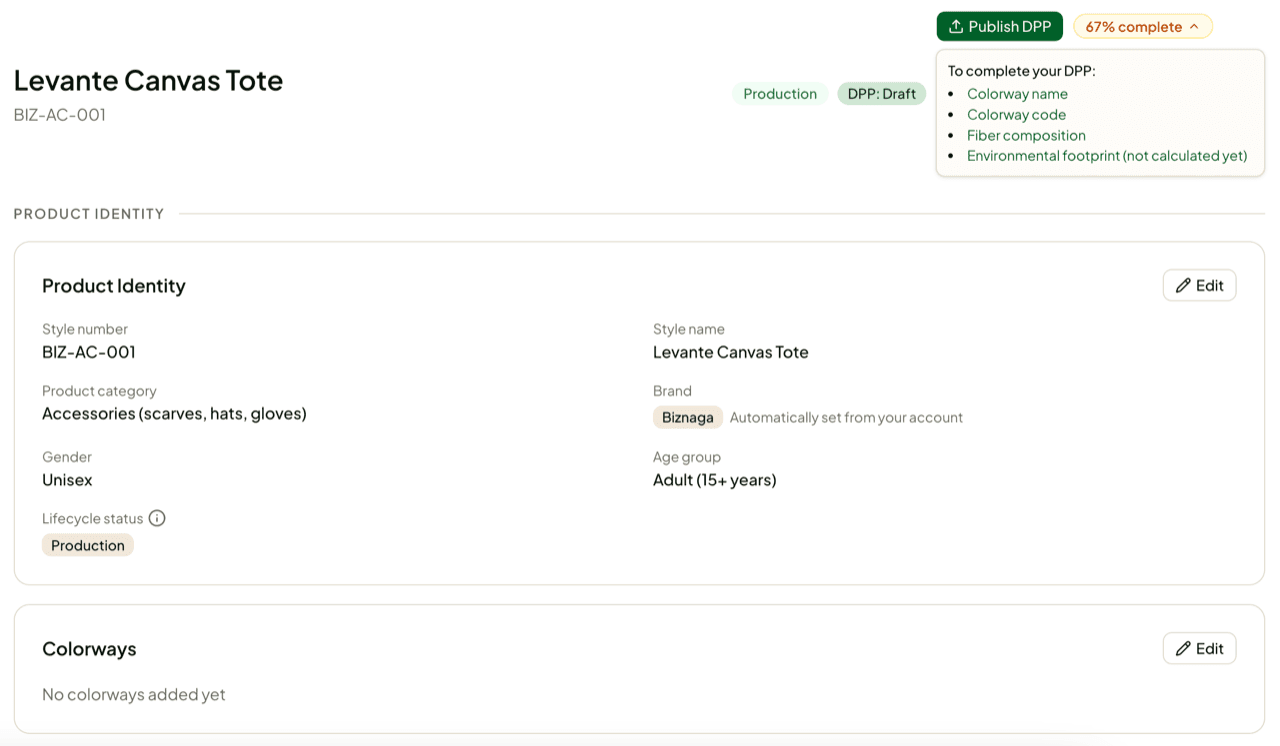
Track completeness across all DPP sections with an actionable readiness checklist.
Material Library
Centralise supplier materials with certifications, test reports, and reusable across products.
Bulk Import
Upload products via XLSX template with validation, partial import, and error reporting.
Built for real workflows

On the roadmap
EF 4.0 ready — architecture built for seamless upgrade when the EU Commission publishes the official dataset.
French Ecoscore compliance module
Automated score calculation aligned with ADEME's Ecoscore methodology for fashion brands selling in France.
Recyclability index
Per-product recyclability score based on material composition, disassembly ease, and local recycling infrastructure.
Recycled content declaration
Certifiable percentage of recycled materials per product, ready for ESPR and EU Ecolabel reporting.
Animal-derived content labelling
Structured declaration of wool, down, leather, and other animal-derived fibres with certification chain-of-custody.
Synthetic leather (PU/PVC) identification
Automatic flagging and labelling of polyurethane and PVC-based materials in compliance with EU transparency requirements.
EF 4.0 dataset integration (EU Commission release)
Architecture already built for EF 4.0. One dataset update — no migration, no breaking changes.
Designed for EU regulatory compliance
EU ESPR
European Sustainability Products Regulation — DPP mandates for textile and apparel products from 2027.
EU Textile Regulation 1007/2011
Fibre composition labelling requirements for all textile products sold in the EU.
GPSR
General Product Safety Regulation — responsible person identification and product traceability.
EU Green Claims Directive
Prohibits vague and unsubstantiated environmental claims. Krelup scans product descriptions and blocks DPP publication when violations are detected.
Get in touch
Interested in early access or have a question? Reach us at hello@krelup.com
What is Krelup?
Krelup is a web-based SaaS platform that helps apparel and footwear brands create EU-compliant Digital Product Passports (DPPs) as required by the EU Ecodesign for Sustainable Products Regulation (ESPR, EU 2024/1781). Brands can publish a DPP in under 5 minutes by entering product materials, supply chain origin, care instructions, and repair information. Krelup automatically calculates the product's Environmental Footprint using the official EU EF 3.1 methodology across 16 impact categories.
EU Digital Product Passport compliance
The EU Digital Product Passport is a mandatory data carrier (QR code, RFID, or datamatrix) that stores standardised product information. ESPR requires DPPs for textile and apparel products from 2027. Krelup generates ESPR-aligned DPP records linked to a public QR code page, covering material composition, supply chain tiers, EF 3.1 scores, repairability index, and end-of-life guidance.
Environmental Footprint EF 3.1 calculation
Environmental Footprint (EF) 3.1 is the EU's official product lifecycle assessment methodology. It evaluates 16 environmental impact categories: climate change, ozone depletion, human toxicity (cancer and non-cancer), particulate matter, ionising radiation, photochemical ozone formation, acidification, eutrophication (terrestrial, freshwater, marine), ecotoxicity, land use, water use, resource use (minerals and metals, fossils). Krelup calculates EF 3.1 scores from fiber composition data automatically.
Green Claims Directive validation
The EU Green Claims Directive (2023/0085/COD) prohibits unsubstantiated environmental marketing claims. Krelup validates product descriptions and marketing copy against Green Claims rules, flagging terms like "sustainable", "eco-friendly", "carbon neutral", or "environmentally friendly" that require EF 3.1 evidence before use. This prevents regulatory fines and greenwashing litigation.
Pricing
Krelup offers a free plan for small brands creating their first Digital Product Passport. Growth plans unlock additional products, multi-user access, and advanced compliance features. No credit card required for the free plan.